

Students searching for information and communication technology (ICT) courses are increasingly choosing New Zealand. In New Zealand, the tech sector is expanding quickly. The nation’s universities have created strong ICT curricula that equip students for a range of challenges in the labour market.
New Zealand universities are known for their innovative learning methods and strong industry ties. In the upcoming years, it is anticipated that the technology market in New Zealand will grow considerably. This will create a large number of jobs for skilled people in fields like software engineering, data science, and cyber security.
Universities in New Zealand are also dedicated to innovation and research. They work closely with industry partners to make sure that IT course material is up-to-date and relevant.
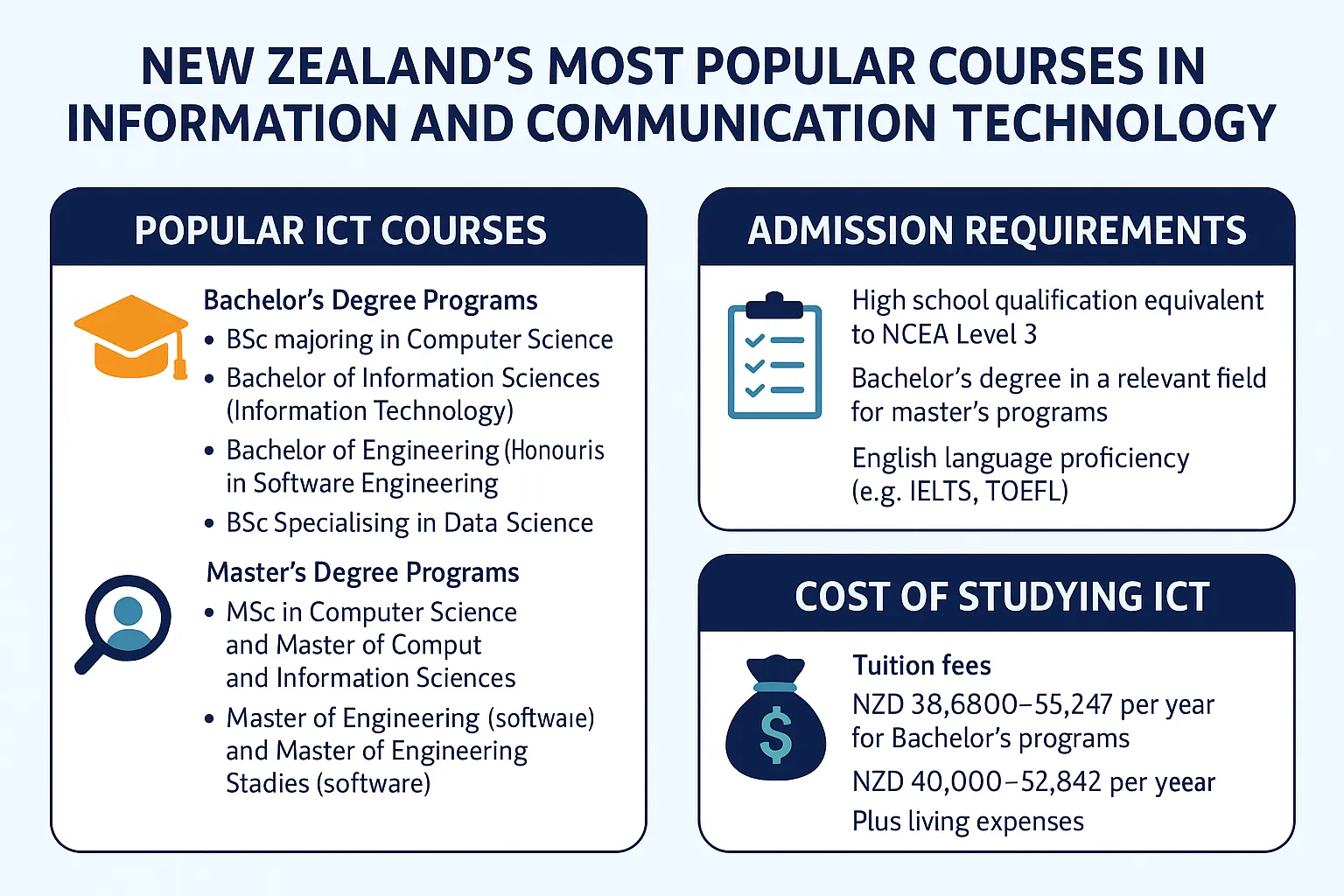
New Zealand universities offer many ICT courses that are designed to meet industry demands and prepare students for successful careers. These IT programmes combine theoretical knowledge with practical skills, giving graduates a competitive edge in the New Zealand job market.
It stands out as a popular choice among international students. This degree covers areas like AI, data science, software development, and cyber security. Universities like the University of Auckland have a comprehensive programme that builds strong foundations in computing principles and allows students to explore specialized fields.
The Bachelor of Information Sciences from Massey University and the Bachelor of Computer and Information Sciences from Auckland University of Technology are excellent options for students interested in cybersecurity, networking, cloud computing, and artificial intelligence. These degrees focus on developing both technical skills and problem-solving abilities that employers value.
The Bachelor of Engineering (Honours) in Software Engineering provides in-depth training in programming languages, robotics, machine learning, operating systems, and software design. This degree equips students with the expertise to build complex software systems from scratch.
It has gained popularity as organizations are increasingly relying on data-driven decision-making. In this programme, students learn database administration, database management, and statistical modelling. These skills are in high demand across various industries.
The MSc in Computer Science and Master of Computer and Information Sciences are research-based programmes that are best for students planning to pursue doctoral studies or specialized research roles. These degrees allow students to explore popular computing topics under expert guidance.
These programmes focus on practical skills for IT leadership positions. They help students in developing advanced technical knowledge with management capabilities. This prepares students for senior roles in technology companies.
The Master of Data Science addresses the growing demand for data analysts in New Zealand’s business sector. Students learn advanced techniques for extracting insights from complex datasets. These skills are extremely important for companies to stay ahead of the competition.
These programmes help in creating qualified software engineers. They help students to develop advanced software development skills while emphasizing industry best practices.
For students looking for shorter postgraduate qualifications, the Postgraduate Diploma in Science in Computer Science from the University of Auckland, the Postgraduate Diploma in Information Sciences from Massey University, and the Postgraduate Diploma in Computer and Information Sciences from Auckland University of Technology offer focused learning pathways. These one-year programmes provide specialized knowledge in specific ICT areas and often serve as stepping stones to master’s degrees.
Getting accepted into New Zealand’s ICT programmes requires meeting specific academic standards and language requirements. Requirements vary slightly between universities, but most follow similar guidelines.
For bachelor’s degrees, international students need a high school qualification equivalent to New Zealand’s NCEA Level 3. There is a minimum score requirement for applying to bachelor’s courses. Strong marks in mathematics and science subjects are generally expected for enrolment in ICT courses.
Postgraduate applicants must hold a bachelor’s degree in a related field like computer science, information technology, or engineering. Master’s programmes often require a B average or higher in previous studies, while postgraduate diplomas may accept students with slightly lower grades. A research supervision plan must be submitted with the Master’s programme application.
You can also get into a Master’s programme after one year of postgraduate study which was completed subsequent to an undergraduate degree. There is also a requirement for minimum grades.
English language proficiency is mandatory for all international students. Most universities accept IELTS (academic) scores of 6.0 for undergraduate courses and 6.5 for postgraduate studies. TOEFL and PTE Academic tests are also widely accepted.
Application deadlines are from October to November for programmes starting in February and March. It’s important to be certain about the application deadline for your chosen course, as it might be different from other courses. Most universities recommend applying early, as ICT courses are often in high demand.
New Zealand’s technology sector is growing at a rapid pace which is creating excellent job prospects for Information and Communication Technology graduates. The country is facing a shortage of skilled tech workforce. This puts qualified IT graduates in a strong position when entering the NZ job market.
Software programmers and engineers are among the most sought-after professionals in New Zealand, with companies across various industries competing for talent. Developer programmers are also in high demand as they help in building and maintaining applications for businesses, while systems analysts design and improve IT systems to meet organizational needs.
Data analysis jobs have become important for companies in various industries. This has made data analysts and database administrators highly valued in New Zealand. These roles involve managing large datasets and extracting meaningful insights to guide decision-making.
Network engineers and systems administrators also are in high demand as they keep organizations’ IT infrastructure running smoothly, while cybersecurity specialists protect sensitive information from threats. These roles have seen increased demand as digital security concerns keep on growing.
Information and communication technology courses in New Zealand prepare students to find high-demand jobs such as Software engineers, ICT managers, developer programmers, systems administrators, ICT security specialists, and database administrators.
New Zealand’s post-study work visa pathway makes the country more attractive to international ICT graduates. This allows students to gain valuable work experience after graduation, with options leading to residency for people in skilled occupations. There are many jobs in the ICT industry that are on New Zealand’s Green List. These high-demand jobs create pathways to residency for qualified professionals.
Many graduates find opportunities with innovative tech companies in Auckland, Wellington, and Christchurch.
Understanding the financial commitment of studying ICT in New Zealand will help you to plan effectively. The overall expenses include tuition fees, living costs, and other essential expenses.
The total fees for ICT programmes vary depending on the university and degree level. Bachelor’s degrees typically range from NZD 38,680 to 55,247 per year, including both tuition and student service fees. These undergraduate programmes are usually for three years, though some specialized degrees like the Bachelor of Engineering (Honours) may require four years.
Master’s programmes cost between NZD 40,000 and 52,842 annually, with most courses taking one to two years to complete.
Postgraduate Diplomas offer a more affordable option at NZD 36,730 to 52,842 for a one-year programme. These diplomas will provide you with specialized knowledge without the full-time commitment of a master’s degree.
Beyond tuition, students should budget for living expenses like accommodation, transport, food, and utility bills. Auckland tends to have higher living costs than other New Zealand cities.
Additional expenses include medical and travel insurance (mandatory for most international students), textbooks, and course materials. Many universities offer scholarships specifically for international students, which can significantly reduce the financial burden.
New Zealand offers a great environment for international students pursuing ICT courses. The country’s growing technology sector provides a good number of opportunities for practical experience through internships and projects with leading companies. This practical approach ensures students develop relevant skills that employers value.
ICT qualifications from New Zealand are globally recognized and open doors to career opportunities worldwide. The post-study work rights and pathways to residence allow students to build rewarding careers in New Zealand.
If you have any queries regarding choosing the right course and education provider in New Zealand, please get in touch with our licensed immigration advisers using our contact us page.

























An increasing number of skilled professionals are choosing a structured...

Let’s talk honestly. A partnership visa is not just a...

Many nurses from Nepal who hold a PCL qualification want...

Immigration New Zealand (INZ) has confirmed a series of planned...

For many students, studying in New Zealand is a big...

For many Indian students planning to study in New Zealand,...

For many couples, the most stressful part of a New...

For thousands of Indian students dreaming of studying in New...

New Zealand’s New Seasonal Visa Pathways: Key Rules, Risks, and...

Applying for a New Zealand partnership visa is far more...