

For educators looking to take their career global, teaching in New Zealand offers a unique combination of professional growth and an enviable lifestyle, along with the assured pathway to a Residence Visa. With a critical shortage of qualified educators across the country, the demand for overseas talent is higher than ever.
New Zealand is actively recruiting for New Zealand teaching vacancies across all sectors—Early Childhood (ECE), Primary, and Secondary. To attract top talent, the government has also streamlined residence visa pathways, making it easier than ever to become a registered residence visa holder teacher in NZ.
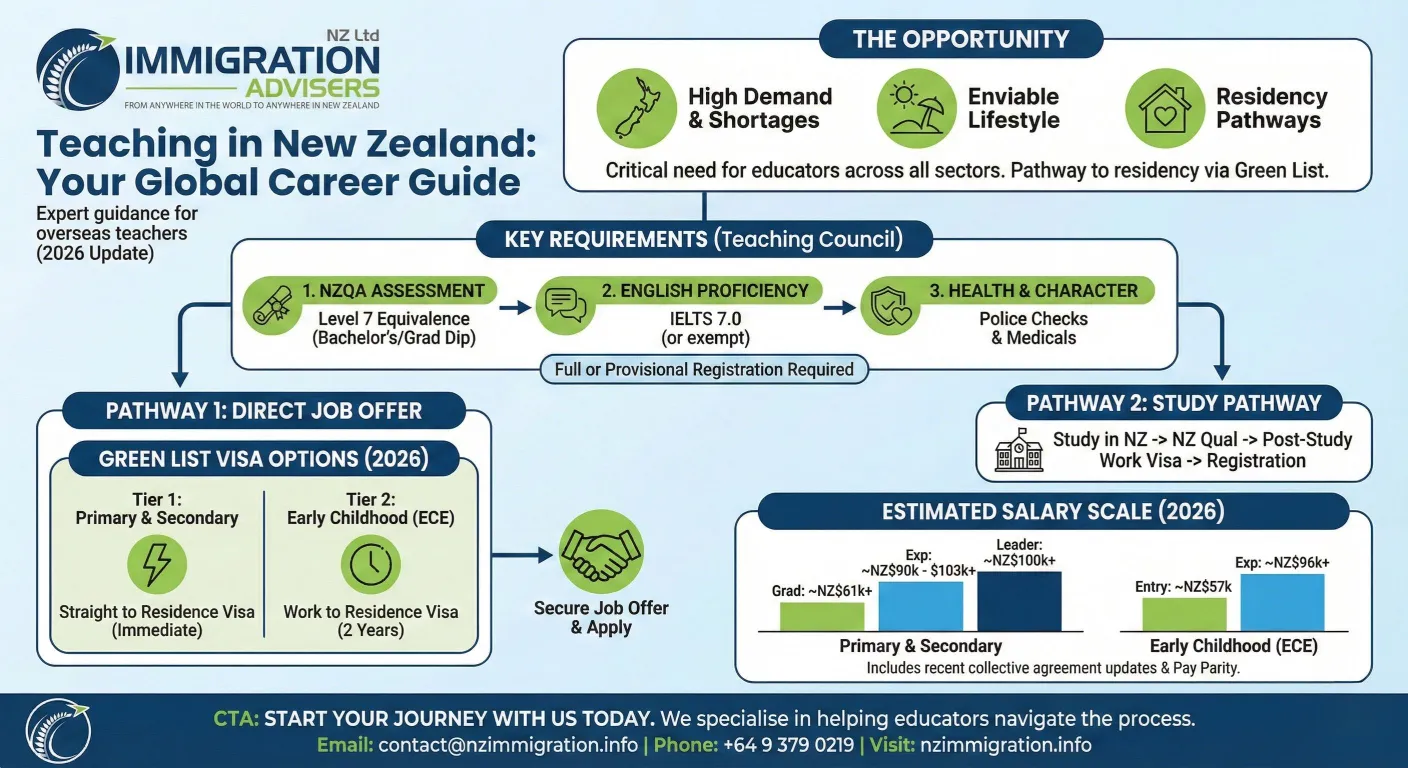
One of the biggest draws for overseas teachers is the inclusion of teaching roles on New Zealand’s “Green List.” This list prioritizes high-demand roles for residency visas.
Before you can apply for New Zealand teaching jobs, you must meet the standards set by the Teaching Council of New Zealand. This is the regulatory body that ensures all teachers meet specific qualifications and ethical standards.
To teach in New Zealand, you generally need a qualification that leads to Teachers Registration on New Zealand, and could be at Level 7 or Level 9on the New Zealand Qualifications Framework (NZQF.
Communication is vital in the classroom. If English is not your first language or your qualifications were not conducted in English, you must prove your proficiency.
To protect students, all registered teachers NZ must be of good character and health.
There are two main routes to teach in New Zealand.
This is the most common route for qualified teachers.
If your current qualifications don’t meet the requirements to become a professional teacher in New Zealand, you can study locally. Completing a recognized course in NZ not only qualifies you to teach but also immerses you in the local curriculum (Te Whāriki or the NZ Curriculum).
Salaries for teachers in New Zealand have seen significant updates in recent collective agreements (2024–2026), making the profession more financially rewarding. Pay is generally determined by your qualifications and years of experience.
Some schools in “hard-to-staff” areas (often rural) offer isolation allowances or relocation grants, sometimes worth up to $3,500 – $5,000.
Beyond the paycheck, teaching opportunities in New Zealand offer a chance to work in a holistic, student-centred education system. Whether you are looking at how to apply teacher in new Zealand roles for a short-term adventure or a permanent move, the profession is respected and vital to the community.
New Zealand is calling for passionate educators to join its world-class education system. With the Green List offering streamlined residency pathways and salaries rising to recognize the value of teachers, 2026 is the ideal year to make your move.
However, navigating the dual requirements of the Teaching Council of New Zealand and Immigration New Zealand can be complex. A single error in your Qualification Assessment (NZQA) or visa application can lead to significant delays. To ensure your journey is smooth and successful, professional guidance is essential.
Don’t let paperwork stand between you and your dream job. At Immigration Advisers New Zealand Ltd, we specialize in helping educators navigate the specific requirements to teach in New Zealand.
We understand the unique challenges overseas teachers face and can assist you with:
Start your journey with us today.
The core requirements to become a professional teacher in New Zealand include:
No, you cannot teach in a state or state-integrated school without registration. It is a legal requirement to be a registered teacher in NZ to hold a permanent teaching position. Limited Authority to Teach (LAT) exists for specific short-term cases, but for those seeking long-term teaching opportunities in New Zealand and residency, full registration is mandatory.
Yes, there is a significant demand for teachers. Teaching in New Zealand is currently listed on the official "Green List" of hard-to-fill roles.
This high demand makes it an excellent time to browse New Zealand teaching vacancies and apply.
As of 2026, teacher salaries in New Zealand are competitive.
Most New Zealand teaching jobs strictly follow the collective agreement pay scales.
The timeline can vary. An NZQA International Qualification Assessment (IQA) typically takes 25 working days, while the teachers registration NZ process with the Teaching Council can take another 4–8 weeks depending on the complexity of your documents. We recommend starting this process at least 3-4 months before you intend to teach in New Zealand.
You can find teaching opportunities in New Zealand through the official Education Gazette (the main source for NZ teachers gazette listings) or commercial job boards like Seek. However, securing the job is only half the battle. Immigration Advisers New Zealand Ltd helps you navigate the subsequent visa application to ensure your transition to the classroom is seamless.
Generally, yes. To apply for the Accredited Employer Work Visa (AEWV) or the Straight to Residence Visa, you need a confirmed full-time job offer from an accredited New Zealand school. However, you can start the teachers registration NZ process before you have a job offer, which makes you a much more attractive candidate to employers.























An increasing number of skilled professionals are choosing a structured...

Let’s talk honestly. A partnership visa is not just a...

Many nurses from Nepal who hold a PCL qualification want...

Immigration New Zealand (INZ) has confirmed a series of planned...

For many students, studying in New Zealand is a big...

For many Indian students planning to study in New Zealand,...

For many couples, the most stressful part of a New...

For thousands of Indian students dreaming of studying in New...

New Zealand’s New Seasonal Visa Pathways: Key Rules, Risks, and...

Applying for a New Zealand partnership visa is far more...